HOW IT WORKS
3D Printed Wall Images: How the Illusion Works
The depth in a 3D wall mural is drawn, not built. Here's how perspective, shadow and one chosen viewpoint make a flat wall open up.
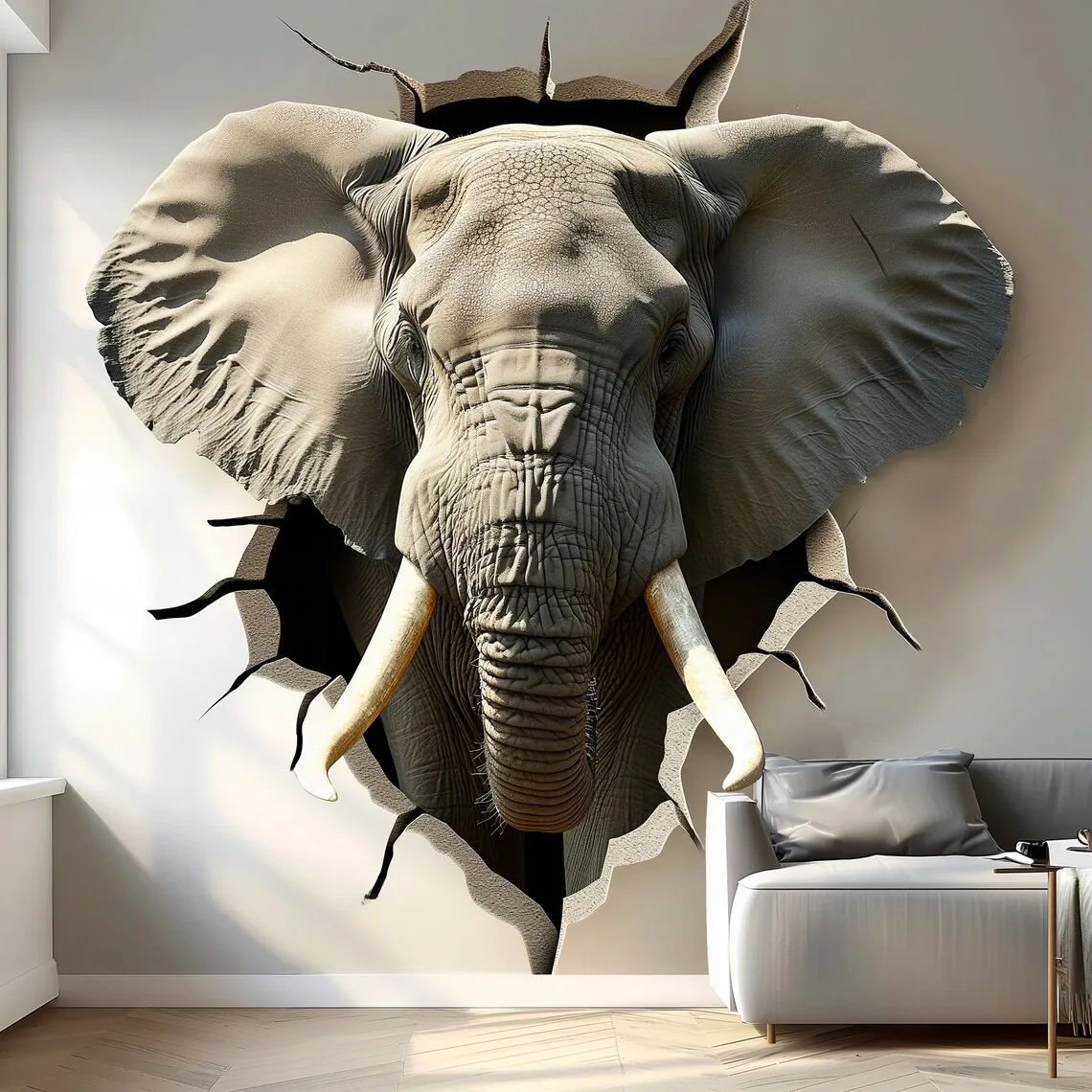
People search for “3D printed images” meaning two completely different things. One is additive 3D printing — a machine building a physical object up in layers of plastic or resin. The other is a flat image printed so convincingly that a wall appears to break open, and something appears to lean out of it. We do the second. It is worth being plain about that up front, because the two get confused constantly and only one of them ends up on your living-room wall.
What is actually on the wall
A 3D wall mural is ink on a flat surface. We print colour, not relief. Run your hand across a finished 3D wall and you will feel plaster, brick or concrete — exactly what you felt before we arrived. Nothing is raised, moulded or built up. That sounds like a limitation until you consider the alternative: there is nothing standing proud of the wall to chip, catch a shoulder, collect dust or peel away at the edge. The illusion is doing all the work, and illusions do not wear out.
Your brain does most of the job
This is the part people find surprising. Your eyes never receive a three-dimensional image in the first place — what lands on the retina is flat, and the brain reconstructs depth from a set of learned cues. Vision researchers call the ones that work with a single eye monocular depth cues, and a mural can reproduce every one of them:
- Occlusion — when one shape covers another, we read the covering shape as nearer. Broken plaster edges overlapping the scene behind them do exactly this.
- Cast shadow — a shadow falling on the surface below an object tells you it is sitting in front of that surface rather than painted on it.
- Linear perspective — parallel lines converge as they recede. It is why a corridor drawn into a wall reads as a corridor.
- Texture gradient — surface detail gets finer and more densely packed with distance, so rubble in the foreground is crisp and the space beyond it is not.
- Relative size — two things you know to be the same size read as near and far when one is drawn smaller.
Get those five right and the wall opens up. Get the shadows falling the wrong way for the room's real light and it stubbornly stays a picture — which is why we ask where your windows are.
Where you stand decides everything
There is a long history behind this. Trompe-l'œil — French for “deceives the eye” — is the tradition of painting so convincingly that the viewer takes the depicted thing for real, and it holds up from an ordinary standing position. Anamorphic art is its stricter cousin: the image is deliberately distorted and only resolves from one exact spot, which is the trick behind pavement art that looks like a chasm through a phone camera and like a smear from anywhere else.
Wall murals sit near the trompe-l'œil end, but the principle still applies: a 3D design is drawn for a viewpoint. We set the vanishing point where people actually stand — the doorway, the desk, the end of the sofa — and the effect is strongest from there, softening as you move off that line. A design built for the doorway of a gym will not perform from a chair two metres to the side. Tell us how the room is used and that decision gets made properly.
What makes a wall a good candidate
- Room to stand back. Around 2.5m of clear floor gives the illusion somewhere to land. In a narrow hallway we will usually steer you to a design that works up close instead.
- A reasonably smooth surface. Drywall and rendered walls give the cleanest depth. Brick and concrete still work, but the real texture competes with the drawn one — the result reads more as striking artwork on brick than as a hole in the wall.
- Predictable light. A wall lit from one obvious direction is easier to fool the eye on than one washed evenly from every side.
- An uncluttered wall. Sockets, radiators and shelving crossing the illusion give the game away, because they are unmistakably flat objects sitting on a surface that claims not to be one.
Printed, not painted
Hand-painted trompe-l'œil is a genuine craft and takes a skilled artist days or weeks. Printing the same illusion directly onto the wall takes hours, and because UV ink cures the instant it is laid down, the wall is touch-dry and finished when we leave. You also see a proof of the artwork before anything is printed, which is not something a brush offers.
To be fair to the painters: a mural artist can carry an illusion around a corner, over a cornice or across an awkward architectural feature in ways a print pass handles less gracefully, and a one-off hand-painted piece carries a value a printed one does not claim to. If that is what you are aft