
HOSPITALITY
Restaurant Wall Murals: Ideas for Restaurants, Cafés and Bars
Restaurant wall murals that earn their place: where to put one, ideas for cafés and bars, what kitchens rule out, and what a printed wall costs.
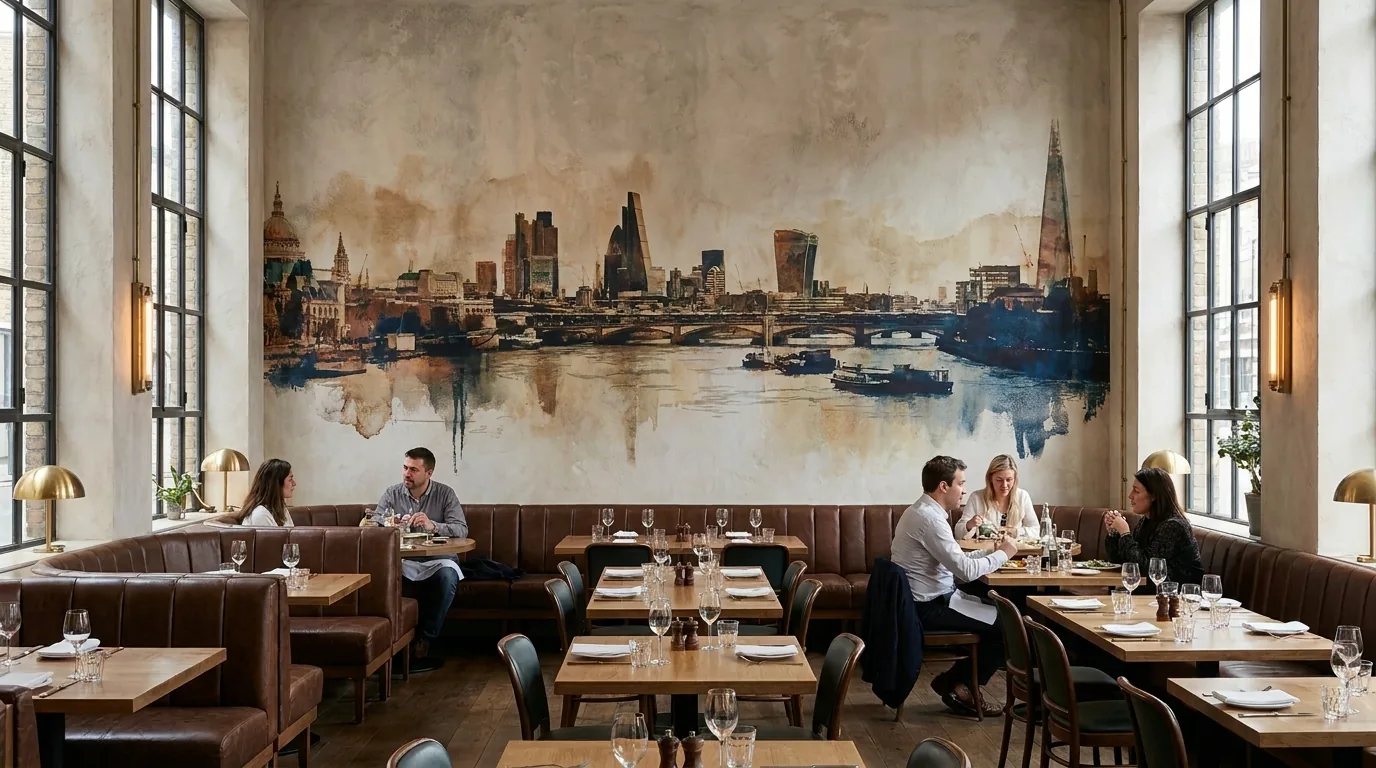
A restaurant, café or bar has one job its walls can help with: being somewhere people remember and want to come back to. A mural is one of the few fit-out decisions a guest actually notices, and one of the few they photograph. This guide covers where a restaurant wall mural works, ideas that suit different kinds of venue, the places we would tell you not to print, and what it costs.
Pick the wall before the artwork
Most venues have one wall that does the work. It is usually one of these:
- The wall facing the door. It is what people see from the street and in the first three steps inside, so it sets the tone before anyone reads a menu.
- The long wall behind banquette seating. The biggest uninterrupted surface in most dining rooms, and the backdrop of every photo taken at those tables.
- The back wall of a narrow café. A strong image at the far end pulls the eye through the room and makes a corridor-shaped unit feel deliberate.
- The route to the toilets or the stairs. A forgotten corridor is a cheap place to be playful, and it is the wall guests have time to look at.
One wall done properly beats four walls done thinly. The rest of the room can stay quiet.
Ideas that suit the venue
- A sense of place. A skyline, a street map of the neighbourhood, or an old photograph of the building or the street outside. It gives regulars something that belongs to them and visitors a reason to remember where they were.
- The story of the food. Botanical drawings of the ingredients, the region the menu comes from, a coffee farm, a vineyard, a harbour. It works best as illustration with room to breathe, not a collage of stock photos.
- Your logo on the building itself. A mark printed straight onto exposed brick or timber reads as part of the fabric of the place, not as signage. Our brick wall printing page shows how ink sits in the texture.
- Dark and atmospheric for bars. Deep botanicals, smoke and ink textures, or a single oversized image on a dark ground. These hold up under low evening lighting, where pale, fine-lined artwork disappears.
- Line art and lettering for cafés. Hand-drawn illustration, a short line of type, a pattern built from your own motif. Light, quick to read from the queue, and easy to live with every day.
- Depth where the room is small. An archway, a window or a view drawn in perspective can make a tight room feel as if it opens up. That is a 3D effect mural: an illusion in ink on a flat wall, nothing raised.
Whatever the idea, design for the lighting the room really has. Ask for a proof and look at it on a phone in the venue during evening service, not on a bright laptop at midday.
Where not to print: kitchens and prep areas
A mural belongs in the dining room, the bar and the corridors. It does not belong in the kitchen. UK food hygiene law sets a specific standard for walls in rooms where food is prepared: they must be easy to clean and, where necessary, disinfect, using impervious, non-absorbent, washable materials with a smooth surface. That is why kitchens are lined with hygienic cladding, tile or stainless steel. Dining areas are explicitly excluded from that rule, so the room your guests sit in is yours to decorate.
Two practical cautions for the front of house as well. Right beside an open kitchen pass or a fryer, any wall finish collects grease, so that is the place for tile or a splashback and the mural goes on the next wall along. And if the building is leased, check what the lease says about decoration before commissioning anything permanent; painting over a printed wall is ordinary redecoration, but some landlords want it agreed in writing.
Why print it instead of painting or papering
A venue has less patience for building work than almost any other space, because a closed day is lost takings. That is where printing directly onto the wall earns its keep.
- It is fast. Most walls are printed in a matter of hours, typically within one day, so the job fits a closed day or the quiet end of the week instead of a week of scaffolding and wet paint.
- Nothing has to dry. The ink is cured by UV light the moment it lands, so it is touch-dry as it prints, with very little odour. You are not airing out a dining room before service.
- No seams and no edges. Wallpaper and vinyl have joins and corners, and in a busy room those are what chair backs, bags and fingernails find first. A printed wall has no edge to lift. We compare the two properly in vinyl or direct-to-wall printing.
- It goes onto what you already have. Plaster, exposed brick, concrete, timber cladding and tile all take ink, so the character of the building stays in the picture.
- It cleans like paintwork. The cured ink resists scuffs and everyday wiping. Treat it as you would a good painted wall, not as a splashback.
The honest limits: the printer reaches up to 4.1m high and cannot print the very bottom or top of a wall, leaving a band of roughly 36–45cm at the base and about 25cm at the top. In a restaurant that lower band usually sits behind banquettes, a dado or the backs of chairs, and we plan the artwork around it from the start. And if you want a hand-painted piece with visible brushwork and an artist's name on it, commission a painter; we set out that choice in printed mural vs painted mural.
What a restaurant wall mural costs
Printing is priced by area and starts from £150 per square metre. The rate moves with the surface and with how detailed the artwork is. As a guide, a 4m × 2.5m feature wall on plaster comes to around £1,467–£1,723, and a 5m × 2.5m exposed brick wall to around £2,330–£2,735. The wall mural pricing guide has a size-by-size table and explains what moves the number.
Before you book
- Check the wall is sound. Damp, flaking paint and live cracks need fixing first, on any finish. Our wall preparation guide lists what to look for.
- Measure it and photograph it straight on. Include the sockets, switches, lights and fire call points; the design has to work around them.
- Decide what the wall is for. Atmosphere, a photo spot, or your name in the room. One clear purpose makes a better mural than three.
- Pick the day. Tell us when you are closed or quietest and we will plan the print around it.
We are based in London and travel further afield. If you would like to see an idea on your own wall first, upload a photo to the free wall designer and try it. Or send a photo and rough measurements through the contact page and we will tell you whether the wall is suitable and what it would cost.


